Last-Minute Navratri Outfits From What You Already Own
Navratri 2026 begins on Sunday, 11 October. If you are reading this with a few days left and no chaniya choli in the cupboard, nothing is lost. Most of a good garba look is styling, not shopping, and the pieces that change an outfit the most are the cheapest ones.
This is the practical version. If you want the full picture, including the nine colours day by day, read our Navratri 2026 outfit guide first. What follows assumes you are short on time.
Start with what garba actually demands
Three or four hours of dancing decides more than any trend does. Whatever you build, it has to flare, it has to breathe, and it has to stay put when you turn. A plain cotton outfit you can move in will always beat a heavy one you are fighting all evening.
That rule is also what makes a wardrobe look work. Everyday clothes are cut for comfort already. They just need the festive layer on top.
Four looks from clothes you already own
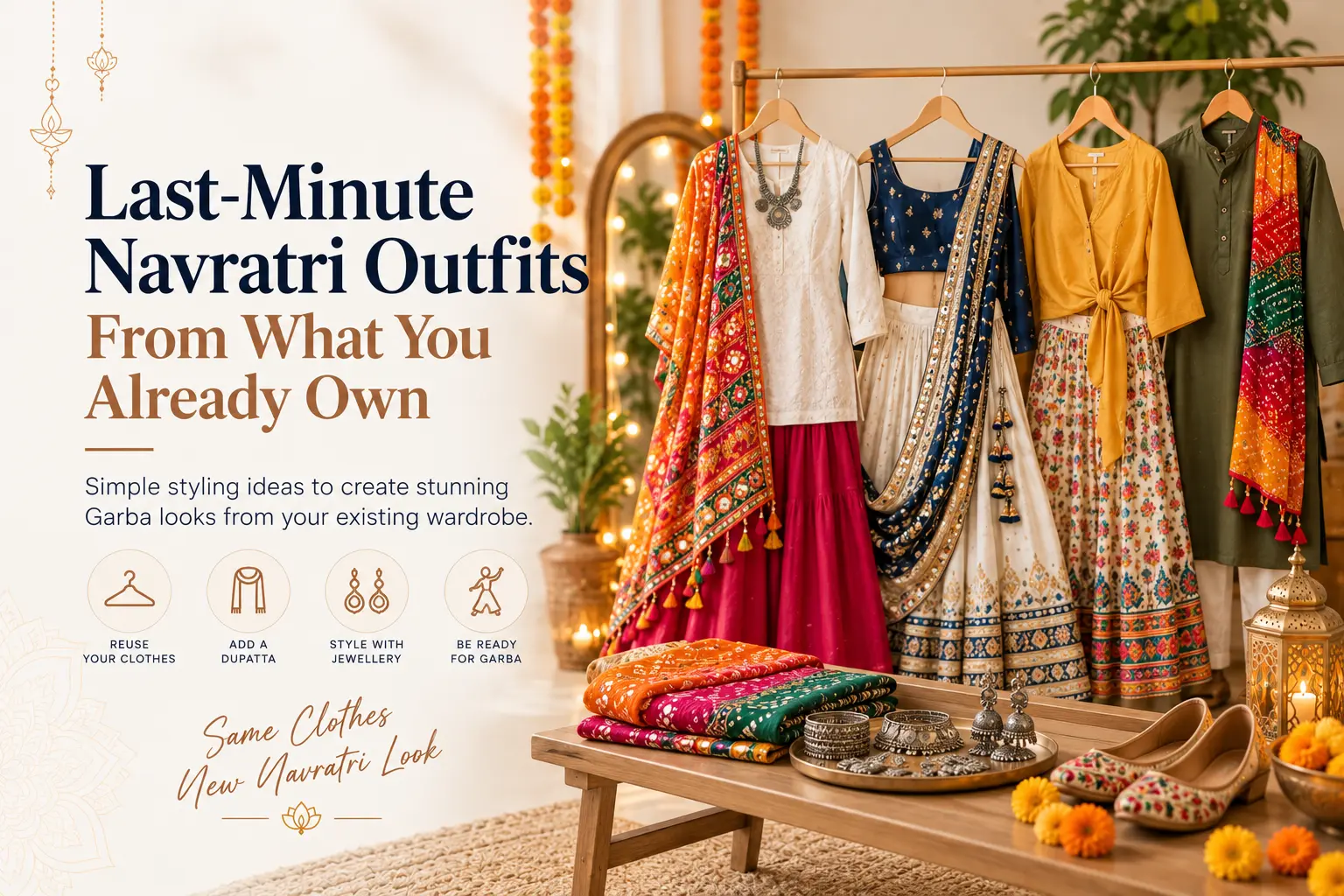
1. Plain kurti, borrowed flare
A short kurti over any flared skirt reads as festive the moment you add a dupatta and a belt. If the skirt is plain, let the dupatta carry the colour of the day. This is the easiest look to repeat across several nights, because only the dupatta changes.
2. A saree, worn as a lehenga
An old cotton or georgette saree can be draped as a skirt with a blouse and a separate dupatta, which gives you flare without owning a chaniya. It takes ten minutes and a few safety pins. Our saree draping styles walks through the drapes if you have not tried this one.
3. Palazzos or a sharara with a crop top
Wide-legged palazzos move almost as well as a chaniya and are far cooler. Pair with a fitted top or a short kurti, add oxidised jewellery, and you have an Indo-western look that does not pretend to be traditional.
4. For men: plain kurta, strong accessories
A solid colour kurta with churidar or jeans is the base. What makes it Navratri is the bandhani stole at the neck or shoulder, a kamarbandh if you have one, and mojris instead of trainers. Our men's ethnic wear guide has more on fit and fabric.
If you are buying, buy these four first
With days to spare, spend on the pieces that restyle everything you already own rather than on one outfit you will wear once.
| Buy | Why it earns its place |
|---|---|
| Dupattas in two or three colours | The cheapest way to hit the colour of the day without a new outfit |
| Oxidised jewellery set | Turns plain cotton into festive instantly, and survives being danced in |
| Kamarbandh or a fabric belt | Defines the waist on a kurti or a draped saree, which is what makes it read as ethnic |
| Flat juttis or kolhapuris | Garba grounds are uneven. Heels end the night early |
A set of good dupattas will carry you through all nine evenings. A single heavy lehenga will carry you through one.
Be honest about delivery
Anything ordered in the next day or two may not reach you before the first night, and that is worth planning around rather than hoping about. Order for the middle and last nights, not for the eleventh, and use your wardrobe for the opening evenings. Ashtami and Navami are usually the dressier nights anyway, so that is where a new outfit is better spent.
If you are ordering for someone else, put their phone number on the delivery address, not yours. That is the number the courier rings.
Nine nights, four outfits
You do not need nine looks. Three or four bases in neutral or repeatable shades, restyled with a different dupatta and jewellery each evening, covers the week and nobody will notice. Keep the heaviest piece for Ashtami.
Afterwards, look after them
Garba clothes take more sweat than almost anything else you own. Air them the same night rather than folding them away damp, wash cottons separately the first time in case the colour runs, and keep mirror work and heavy embroidery out of the machine. Our guide to caring for cotton clothes covers the rest.
Three days is enough. It was never about the chaniya.